
-
Hotel, Lodge, Tea House
-
Private Car/Bus
-
Difficult
-
Full board while on trekking
-
8091m
-
Expedition
-
8-12 Pax
-
Kathmandu, Nepal
Overview
Introduction
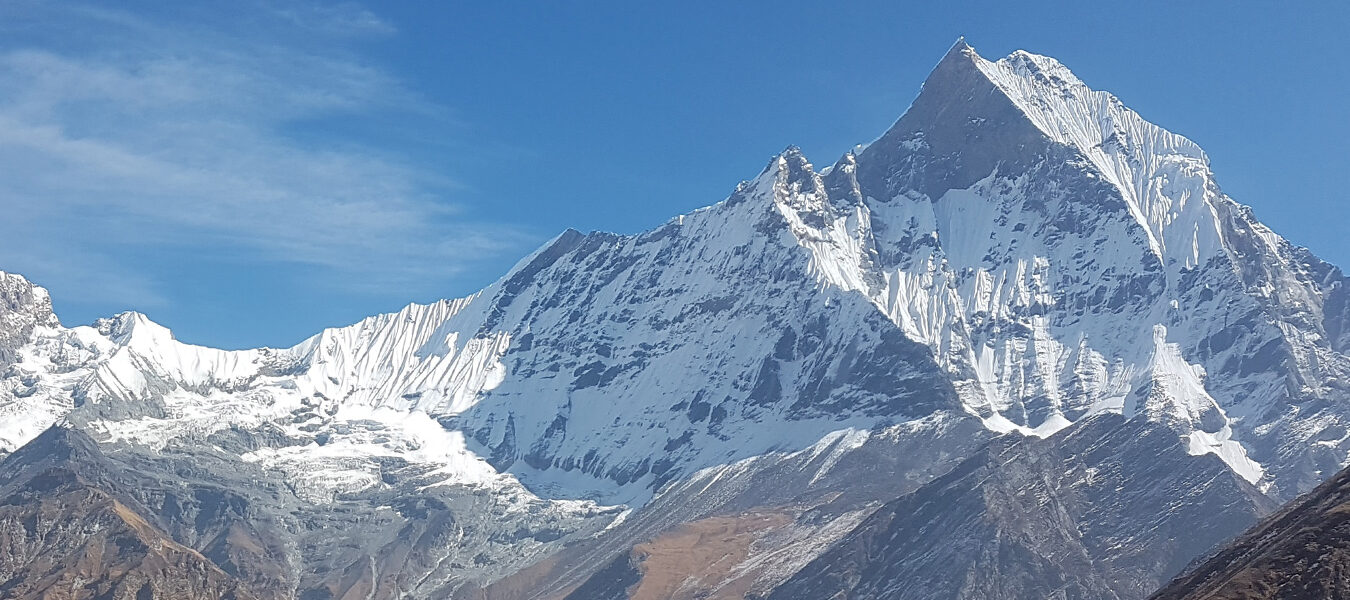
Annapurna 8091m is the thirteen highest mountain in the world. Annapurna is a Sanskrit name which literally means “full of food” but is normally translated as Goddess of the Harvests. This mountain section is a 55 km-long massif bounded by the Kali Gandaki Gorge on the west, the Marshyangdi River on the north and east, and Pokhara Valley on the south. The four summits with the entire massif of Annapurna form the northern barrier of Pokhara Valley. The main summit stands to the west of the Annapurna Sanctuary. The other major peaks on the Annapurna range are Annapurna II (7937 m), Annapurna III (7555 m), Annapurna IV (7525 m), Gangapurna (7455 m) and Annapurna South (7219 m).
The Annapurna peaks are among the world’s most dangerous mountains to climb. Annapurna 8091meter high was first climbed by a French expedition 1950 lead by Maurice Harzog. The entire massif and surrounding area are protected within the 7,629 km2 Annapurna Conservation Area, the first and largest conservation area in Nepal.
Outline Itinerary
Day 01: Arrive in Kathmandu (1320m)
Day 02-03: Expedition Document Application, Preparation, and Briefing for the Expedition
DAY 04: DRIVE TO POKHARA TO BENI
Day 5: Drive to Lete
Day 06: Trek Lete to Jungle Camp
Day 8: Trek to Miristi Khola
Day 09: Trek to Annapurna Base Camp
DAY 10–43: CLIMBING PERIOD OF ANNAPURNA 1 (8091M)
Day 44: Trek to Miristi Khola
Day 45: Trek to the Jungle Camp
Day 46: Trek to Lete
Day 47: Drive Lete to Beni to Pokhara
DAY 48: FLY FROM POKHARA TO KATHMANDU
Day 49: Rest and Shopping in Kathmandu
Day 50: Expedition ends, farewell, and departure
Trip Highlights
- Latitude: 270 51' 42’’ Longitude: 270 51' 42''
- The commercial accent to summit is from Northwest Ridge. Infamous for avalanches, weaker ice en-route and cracked glaciers makes it much riskier.
- Camp 1: Steeper accent yet a moderate climb for the professional climber.
- Camp 2: The climb from Camp 1 to Camp 2 is the most serious and challenging climb. This steeper climbing is vulnerable to avalanches, falling ice and high altitude makes it even challenging.
- Camp 3: Reaching Camp 3 needs few directed climb though seracs using fixed ropes till summit.