
-
2-14
-
Full board while on trekking
-
Hotel, Lodge, Tea House
-
6,476 m
-
Private Car/Bus
-
Kathmandu, Nepal
-
Moderate to Difficult
Overview
Trip Highlights
Explore and experience of summiting three popular peaks of Nepal; Mera Peak at 6461 meters, Crossing of Zatra La Pass 4600 meters, Fantastic views of world’s top Mt. Everest, Mt. Cho Oyu, Mt. Makalu, Mt. Lhotse, Mt. Nuptse, Mt. Baruntse, Mt. Amadablam and more other snow capped mountain ranges, Explore and experience authentic cultural and lifestyle of different euthenics group.
Introduction:
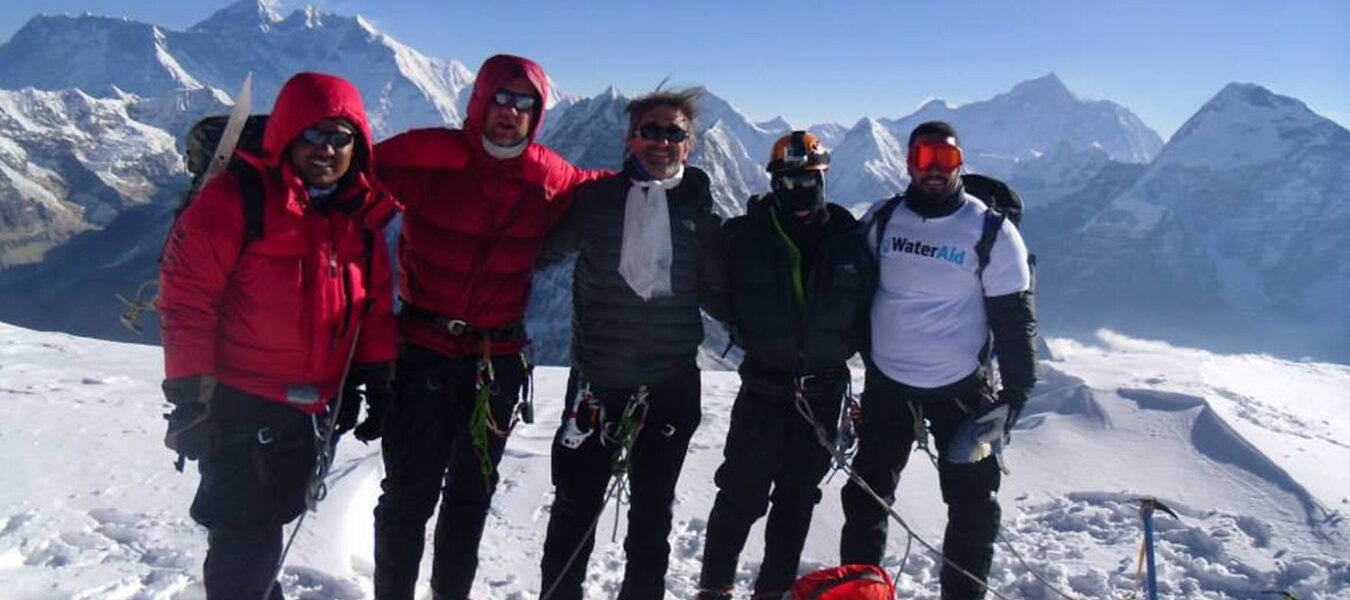
Mera Peak Climbing 6476 m 21 Days, Mera Peak is the uppermost trekking peak in Nepal at above 6000m. The sight from the top is one of the most excellent in the Himalaya with five 8,000m peaks observable: Everest, Lhotse, Cho Oyu, Makalu and Kanchenjunga.
Mera Peak is a mount in the Mahalangur section, Barun sub-section of the Himalaya and managerially in Nepal’s Sagarmatha Zone, Solukhumbu District. At 6,476 metres it is off the record as a trekking peak. It mainly three summits: Mera North, 6,476 metres, Mera Central, 6,461 metres and Mera South, 6,065 meters, as well as a smaller “trekking summit”.
The tallness of Mera is often known as 6654 meters, and claimed to be the highest trekking peak. This figure in point of fact points to nearby Peak 41, which was mistakenly named Mera in a list of Himalayan peaks, and the figures were copied to the official trekking peak list as they were, including the wrong location coordinates.
The first ascent of Mera Central was on May 20, 1953 by Col. Jimmy Roberts and Sen Tenzing (who was known by the nickname The Foreign Sportsman). Mera North was first climbed by the French climbers Marcel Jolly, G. Baus and L. Honills in 1975.The region was first explored extensively by British expeditions in the early 50s before and after the ascent of Everest. Members of those teams included Edmund Hillary, Tenzing Norgay, Eric Shipton and George Lowe.
Jimmy Roberts (1916-1997) was probably the person who can take most of the credit for establishing the trekking industry in Nepal in the early 1960s. He was posthumously awarded the “Sagarmatha (Everest) National Award” by the government in May 2005.
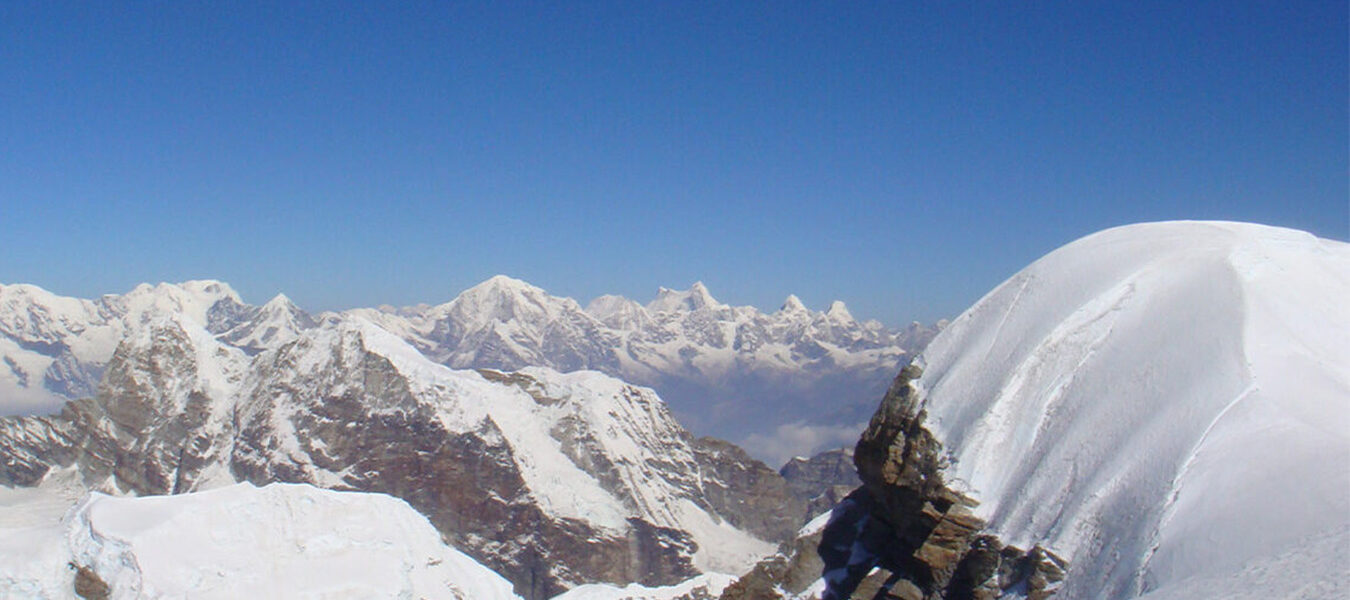
The view from the summit is one of the finest in the Himalaya with five 8,000m peaks visible: Everest, Lhotse, Cho Oyu, Makalu, and Kangchenjunga, as well as other Himalayan peaks linked below. The standard route from the north involves high altitude glacier walking. The ease of reaching this elevation may be its biggest danger but good weather and snow conditions are, of course, necessary for safety and success. The west and south faces of the peak offer more difficult technical routes.
For experienced climbers it is a technically straightforward ascent, the main hurdle being proper acclimatize to the high altitude. These reasons make Mera Peak a very popular destination, with many adventure tour companies offering guided trips to the mountain for clients with little or no mountaineering experience. All climbers are recommended to partake in preparative fitness and altitude training before attempting an ascent.
In 1986 Mal Duff and Ian Tatters all made the first ascent of the south west pillar. The route is approximately 1,800 metres in length and graded at ED inf. The approach to the base of the pillar is extremely exposed to serac fall.
Outline Itinerary:
Day 1: Arrive in Kathmandu
Day 2: Briefing and gear checks in Kathmandu
Day 3: Fly to Lukla and trek to Puiyan (2,800m)
Day 4: Trek to Pangom (2,800m)
Day 5: Trek to Nashi Dingma (2,600m)
Day 6: Trek to Chalem Kharka (3,600m)
Day 7: Acclimatization day at Chalem Kharka (3,600m)
Day 8: Trek to Chunbu Kharka (4,200m)
Day 9: Trek into the Hinku valley near Kote (3,600m)
Day 10: Trek to Tagnag (4,400m)
Day 11: Acclimatization day in Tagnag (day walk)
Day 12: Trek to Khare (5,000m)
Day 13: Acclimatization and glacial skills practice day.
Day 14: Climb to Mera la (5,300m)
Day 15: Climb to High Camp (5,800m)
Day 16: Mera High Camp to Summit [6,461m/21,1907ft] and back to Khare [5045m/16,547ft]: 8-9 hrs
Day 17: Reserve day for Contingency
Day 18: Khare to Kothe [3600m/11808ft]: 4-5 hrs
Day 19: Kothe to Thuli Kharka: 5-6 hrs
Day 20: Thuli Kharka to Lukla: 6-7 hrs
Day 21: Fly to Kathmandu
Note: Fill free to customize your trip. Click here.

Write a Review